A guide to completing the Great Ocean Road Walk

hero media
Are Victoria’s famous Twelve Apostles in fact a ‘faker’s dozen’? Taking the spectacular Great Ocean Walk is the only way to find out (with John Borthwick).

The miscounted limestone stacks we  know as the Twelve Apostles wait patiently offshore like naughty kids who’ve been stood outside for telling porkies. But it wasn’t these ochre columns who fudged their head-count and name…

I’m hoofing along the cliff-beach-river-heath-forest trail known as the Great Ocean Walk with a gaggle of eight other hikers. Our ultimate goal in a few days will be the Twelve Apostles and I figure that as we go, the truth about their misnaming and misnumbering will emerge.

“That was a very punchy first day," says our guide Jenny. Almost like a Melbourne joke we had four seasons come at us in one afternoon: rain, sun, wind, brine, king tide, even hail. But what a heart-charger: oxygen in buckets with an adrenaline chaser.

Day 1

12 Apostles Great Ocean Walk
Do the 12 Apostles really number a dozen? (photo: Mark Roper).

Our first day, of four, ended with us scrambling up the dunes of beautiful Johanna Beach – named after a brig wrecked there in 1843 – with a rising tide snapping literally at our heels.

We clamber to dry ground, panting and ranting with delight. Even better, there’s a van waiting to whisk us – sweaty, wet and salt-caked – to the creature comforts of the Twelve Apostles Lodge.

I soak my feet in its outdoor foot spa, take a hot shower and then head to the big, friendly dining room to refuel on coffee, canapés, wine and wi-fi before a memorable dinner of baked salmon.

Over a dessert of poached pear and ice-cream, Jenny explains that the original, hayseed name of the Twelve Apostles was the Sow and Piglets. Not a great come-hither title for a future luxury lodge, either, I imagine.

Our excursion, a commercial trek known as the Twelve Apostles Lodge Walk, covers four successive sections – 56 kilometres all up – heading westwards to the Apostles on the 104-kilometre Great Ocean Walk public trail.

As lodge guests we don’t camp but sleep and dine in comfort each night, with transfers taking us to and from the trail.

Day 2

Beaches Great Ocean Walk
Wind-swept beaches aplenty (photo: Mark Roper).

Our second day is harder, in fact, the hardest: an eight-hour hike over varying terrain. It’s only 12 kilometres but think hills and gullies, then more of the same.

That said, anyone who’s moderately fit, has stout boots and some intestinal fortitude to match can do it. The name of the beach where we start today, Milanesia, commemorates yet another wreck – one of 638 reasons this is called the Shipwreck Coast.

We ramble on, descending easily at first, sometimes in a group and at other times walking solo with our own thoughts. The vegetation changes as much as the terrain. Tree ferns, towering mountain ash, coastal heath and stands of stringybark give way to gobsmacking cliff-top vistas that stretch from Cape Otway in the east to Cape Volney far ahead in the west.

The Southern Ocean swell is having a tantrum, but the day is fine and the sun is out. On a clearing above Ryans Den we dig out of our day packs lunches of fresh salad and pasta that the lodge chef has prepared. No soggy sangers on this march! Jenny conjures up some sweet treats and we’re off again.

12 Apostles Lodge accommodation
Accommodation at Twelve Apostles Lodge awaits weary legs (photo: John Borthwick).

Our late afternoon ascent towards Moonlight Head is a one-foot-after-another plod up 138 steps cut into this well-groomed track. Surveyor Charles La Trobe (who became the first governor of Victoria) pushed through here in 1846, battling the dense and pathless scrub.

Lying exhausted in his tent at night, he wrote, ‘Had a day of the most severe exertion I ever encountered’.

His dinner that night certainly wasn’t the chicken roulade followed by chocolate cake that the lodge’s resident chef Ha Nguyen serves us. Nor would La Trobe have dreamed of a purpose-built, eco-ticked, centrally heated lodge with en suites.

“We aren’t a boot camp!" declares Dana Ronan happily, co-owner and director of the lodge and walk.

Need tips, more detail or itinerary ideas tailored to you? Ask AT.

AI Prompt

Day 3

Anchors in rock Wreck Beach
Anchors in the rock at Wreck Beach.

Day three sees us wake early and choosing a gourmet kick-starter from the menu, in my case porridge and an omelette. Then it’s boots-on, packs and walking poles ready, and we hit the trail again.

We start at The Gables headland, one of the mainland’s highest cliff-top lookouts, before dropping down to Wreck Beach where several historic shipwreck anchors remain embedded in the rock shelf.

It’s an easier day today, with only 13 kilometres to cover. Rounding a bend in the scrub, we almost collide with two eastern grey kangaroos, much to the delight of Caroline, a Canadian traveller whose sightings to date of Australian marsupials have principally been on tea towels and calendars.

Kangaroo Great Ocean Walk
Eastern greys like the Great Ocean Walk, too.

After lunch near the Devil’s Kitchen we catch our first, distant glimpses of the Twelve Apostles. A good time to tease out more of their story from Jenny and Dana.

It seems that Muttonbird Island near Loch Ard Gorge was known originally as ‘the Sow’ and the smaller nearby stacks as ‘the Piglets’, but in the 1920s a tourism spin-doctor engineered a change from the bacon-friendly original to ‘The Apostles’.

No numbers mentioned. A later spinner, also Biblically inclined but numerically challenged, added ‘Twelve’ to the title, although there were only ever nine little piggies.

Our sunny afternoon hike ends at the Gellibrand River and the village of Princetown, where the van awaits us again with its promise of lodge-lizard indulgence and a good wine and recap session around the foot spa.

The final (half) day

Steps Great Ocean Walk
Your steps counter will thank you (photo: John Borthwick).

The finale is in fact an easy, half-day amble through low coastal scrub with the Apostles looming ever closer. We’re now in Port Campbell National Park with the Great Ocean Road nearby, although still out of sight and earshot.

And then, suddenly, too soon, there they are, just offshore, the celebrated, apostolic piglets, up to their knees in ocean and battered by waves. We drop our packs, the journey done, the kilometres behind us, and clamber down the steep, stone descent of the Gibson Steps.

From the beach, the old red pillars, lathed by the sea and gales, seem like castaways hoping for someone to toss a rope and haul them back to shore. More prosaically, we learn that theses icons were formed by the sea’s relentless erosion of the soft limestone cliffs.

Hollowed-out like Swiss cheese into caves whose roofs then became arches, the surrounding structures were washed away, forming islands with archways. In time those arches collapsed, leaving pillars up to 50 metres high.

With the Apostles, the 12 turned out to be nine. Never mind, but they kept on eroding and in mid-2005 the famous ‘London Bridge’ arch collapsed: one down, eight to go.

The lodge lays on one last thrill for us. We pile into two helicopters for a fly-by, a head-count if you will, of the Sow, Piglets, Apostles, Apostates – call ’em what we may – this faker’s dozen of ancient outriders standing sentinel before a coast of time-gnawed cliffs and shipwreck memories.

Weekly travel news, experiences
insider tips, offers, and more.

The details: Great Ocean Walk

Helicopter flight 12 Apostles
The walk culminates in a helicopter flight over the Twelve Apostles (photo: John Borwick).

Getting there: Twelve Apostles Lodge Walk is located at Johanna, 250 kilometres (three hours’ drive) from Melbourne on the Great Ocean Road; transfers to/from your Melbourne hotel or airport are included in the tariff.

Playing there: The Twelve Apostles Lodge Walk is an all-inclusive, four-day/three-night, lodge-based excursion. The walk, graded moderate and priced from $1995 per person, includes accommodation, meals, outdoor gear, guide, transfers and a 10-minute helicopter ride finale. There is no single supplement charge. Standard group is 10 walkers, and it runs from September to May.

Want to see more stories from Australian Traveller in your Google search results?

  1. Click here to set Australian Traveller as a preferred source.
  2. Tick the box next to "Australian Traveller". That's it.
hero media

Farm fresh produce to a trail of lights: the ultimate guide to Mildura

    Rachel Lay Rachel Lay
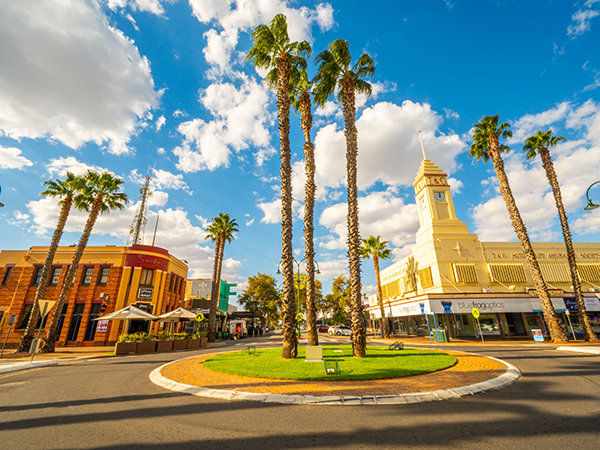
    The charm of Mildura is hidden in plain sight along the Sturt Highway. The capital of Tropical North Victoria is in a league of its own.

    From the moment you arrive in Mildura, the warm air and palm trees invite you to slow down. While most Australians might drive right past it, Mildura is full of surprises. Here you’ll spend one day witnessing over 50,000 years of First Nations history in a UNESCO-listed National Park, and the next dining in a hatted restaurant after wandering through 12,500 fireflies as the outback sunset bursts to life above. From roadside fruit stalls and family-run wineries to houseboats and galleries, it’s time to explore Mildura.

    Feast Street, at the heart of Langtree Avenue in Mildura.
    Taste, wander and be surprised in Mildura.

    Taste Mildura’s produce

    It makes sense to start your trip by addressing the most important question: where to eat. In the beating heart of Australia’s food bowl, sample the local produce directly from the source. And then, of course, experience it through the menu of a hatted chef. Or sandwiched between pillowy slices of Nonna’s ciabatta.

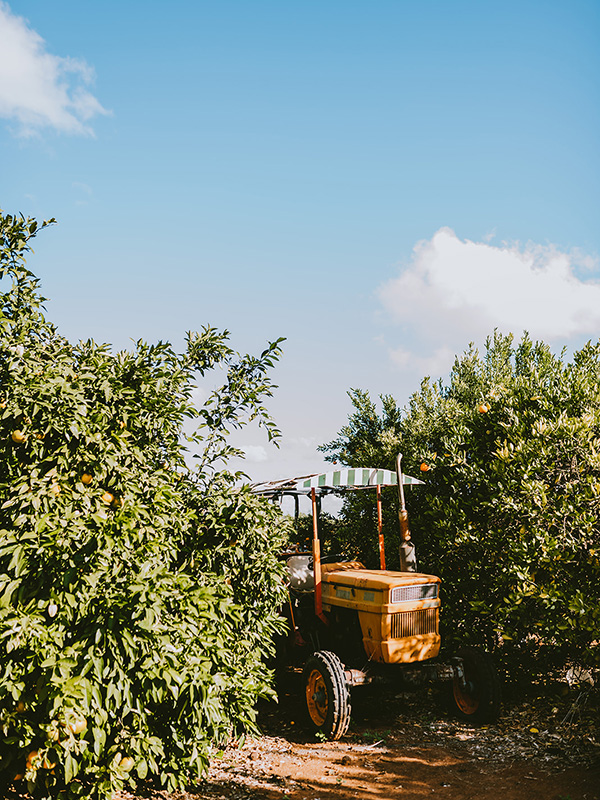
    Rows of orchards and olive groves invite you to spend the day traipsing from farm to farm. Taste olives propagated from Calabrian trees brought over in the 40s, oranges picked right from the tree and squeezed into juice and spoons full of honey. Bring the holiday back to your kitchen by stocking your pantry at roadside produce stalls, or calling into the ‘silver shed’ (Sunraysia’s gourmand Mecca).

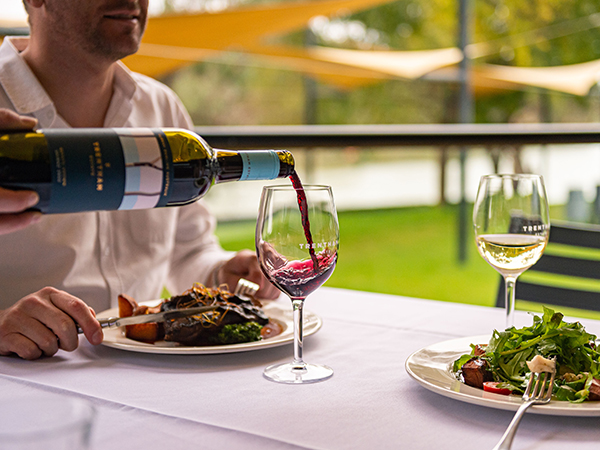
    Thanks to the warm, balmy air and fertile soils, the wineries dotted along these hills produce award-winning local wines. Like Chalmers, a family-run, innovative winery dedicated to making their wines as sustainable as possible. And picturesque Trentham Estate offers views of the snaking Murray River as you sample their vintages.

    Venture beyond the gnarled shadows of olive groves and fragrant rows of blossoming fruit trees and you’ll find an otherworldly side to Mildura. With Discover Mildura as your guide, visit Murray River Salt’s Mars-like stacks. The naturally pink salt is formed from an ancient inland sea and evaporated entirely by the sun to create one of the region’s most iconic exports.

    Start your day with just-squeezed sunshine.

    Hatted dining & Italian history

    Mildura is home to a proud community of Calabrians and Sicilians. This, paired with the exceptional local produce, means that you can find paninos on par with those in Italy. The Italian is a Paninoteca serving up made-to-order, hefty, authentic Sicilian paninos. Nonna Rosa’s pork meatballs, slowly cooked in tomato ragu and served in a crusty, fluffy roll topped with gratings of Grana Padano cheese and salsa verde, will call you back to Mildura for the rest of your days.

    To find hatted dining in Mildura, simply follow the staircase down into the basement of the historic Mildura Grand Hotel to find Stefano’s. Following the muscle memory and instinct of his Italian roots, he delivers on the principle of ‘cucina povera’. That is, the Italian cooking ideology that turns simple, local ingredients into magic.

    Things to do in Mildura include dining at the acclaimed Stefano’s, where simple local ingredients are transformed into Italian culinary magic beneath the historic Grand Hotel.
    Bite into Mildura’s Italian heritage.

    Discover a thriving culture scene

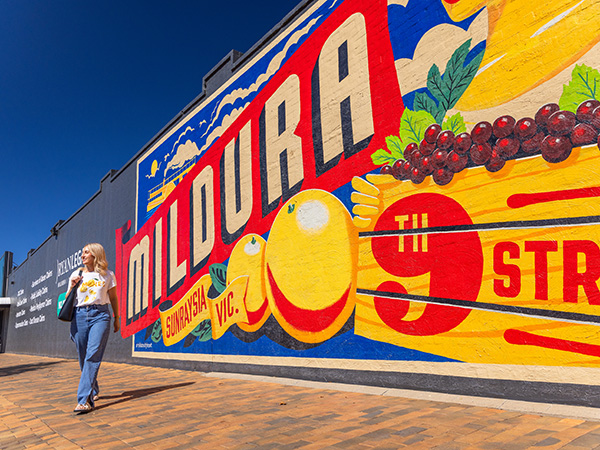
    The city is alive with culture. Whether it’s painted on the town’s walls, told in ancient yarns, or waiting for you in a gallery.

    The Mildura Arts Centre was Australia’s first regional art gallery. Behind the walls of Rio Vista Historic House, you’ll find a lineup of ever-changing exhibitions. The gallery’s wall space pays tribute to the art and songlines of local First Nations People, the region’s awe-inspiring landscapes and more. Outside, on the gallery’s lawn, find 12 contemporary sculptures in the Sculpture Park.

    Mildura’s streetscapes are a punch of colour. Swirling strokes of paint blend the winding artery of the Murray River, red dirt and local characters into a story you can see with your own eyes, thanks to the Mildura City Heart’s Mural Art Project. Pick up a copy of the Murals of Mildura guide from the Visitor Information Centre.

    Follow the border of NSW and Victoria on a map and you’ll see it hugs the curves of a tiny island on the Murray. That’s Lock Island, where, as the sun and moon trade places, the island comes alive as darkness falls. The island is dotted with 12,500 firefly lights that lead you on a meandering path through the outback sunset. The installation is known as Trail of Lights and was created by the same visionary who dreamt up Field of Light at Uluṟu, Bruce Munro.

    Things to do in Mildura include exploring its rich cultural scene. From vibrant street art and ancient stories to exhibitions at the Mildura Arts Centre, Australia’s first regional gallery.
    Find culture around every corner.

    Wonder at ancient landscapes

    The landscapes of Mildura feel almost transcendental. The skyline bursts to life with reds, pinks, and deep, sparkly night skies.

    The nature will leave you in awe. See hues of pink water changing with the weather at Pink Lakes inside Victoria’s largest national park, Murray Sunset National Oark. Cast a line into Ouyen Lake. Watch the sunset against 70-metre tall red cliffs that reflect the setting sun. Or get the heart racing and sandboard down the Perry Sandhills dunes, formed 40,000 years ago at the end of an ice age.

    Just don’t leave without following the twists and turns of the Murray. Stroll or ride along the Shared River Front Path, or jump onboard a boat for a scenic ride.

    Your itinerary will be incomplete without a visit to UNESCO World Heritage-listed Mungo National Park. Head out with an Indigenous ranger to witness ancient campsites and footprints, before standing in awe of ancient civilisation near the discovery site of Mungo Man—Australia’s oldest human skeleton at 42,000 years old.

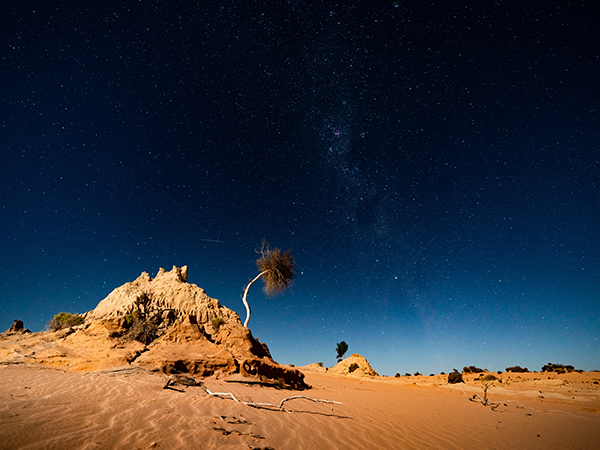
    Mungo National Park at night is a vast, silent landscape where ancient dunes glow under moonlight and stars blanket the sky in breathtaking clarity.
    Walk in the footsteps of ancient civilisation.

    Meet your home away from home

    On equal par with planning your meals and adventures, is finding the perfect place to relax at the end of each day.

    Sleep inside a Palm Springs postcard at Kar-Rama. A sleek boutique hotel complete with a butterfly shaped, sun-soaked pool. Here you’re staying right in the heart of Mildura but you’ll feel worlds away. Or if you really wish to connect with nature, a night glamping under the stars at Outback Almonds will have you spellbound.

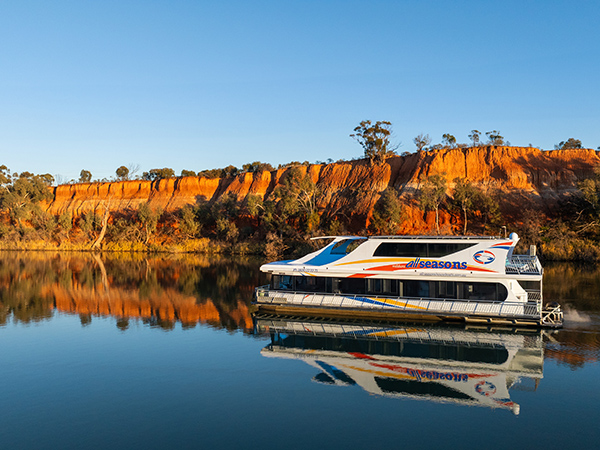
    When in Mildura it’s only right to stay on one of the Murray River’s iconic houseboats. Wake up each day to the calm waters of the Murray lapping outside your window. Enjoy days full of river swims, fishing and exploring. All boats are solar-powered and can be self-skippered or moored along the river.

    A solar-powered houseboat on the Murray River in Mildura.
    Stay and play on the Murray in a solar houseboat.

    Start planning the perfect getaway at mildura.com.

    A guide to completing the Great Ocean Road Walk