Food photography 101: the good, the bad, the unforgivable

hero media
Ready to go next level with your iPhone food photography but not sure how? We hit up a couple of professional food photographers to get the download on how to find the right angles and style each shot, as well as what to avoid and how not to make a nuisance of yourself.

Remember the days when waitstaff would arrive at your table with a plate of food and you would take a cursory pause to appreciate how nice it looked before getting stuck straight in before it went limp, cold or congealed? Oh, the memories. These days our dining habits are driven by how many likes we can clock up for close-ups of Nutella-oozing doughnuts or jaunty Boomerangs of clinking glasses of Mumm.


In this world, limp lettuce is just accepted as collateral damage on the quest for Insta greatness. How do I know this? Because I, too, am guilty of getting sucked into the addictive frenzy of: “If you don’t ’gram it, it never happened." But as much as I would love my Instagram feed to look like a thoughtfully curated and perfectly shot #sneakpeek into my fantasy foodie exploits, I have to admit that my own attempts at food photography don’t always cut the truffle mustard.


I get to hang out on shoots a lot in my job, so I know that all those elegant flat-lays and perfectly juicy burger close-ups are never just down to good luck and good timing – there’s a lot of skill and some very considered wisdom guiding the way. To find out how to elevate my own humble iPhone pics to double-click-worthy new heights, I decided to grill a couple of my professional food photographer pals for their best tips and tricks.


Peter Tarasiuk is a professional food, travel and lifestyle photographer based in Melbourne. He has worked on cookbooks for major publishers and shoots for a range of leading magazines in Australia and overseas. Shellie Froidevaux started out as a food blogger, back when Instagram was considered fledgling and niche. Today she has over 43,000 Instagram followers and is a professional recipe developer, food stylist and photographer. She also runs her own business teaching regular folks how to style and shoot food like a pro.

Ready to ace your next smartphone shoot? Read on for Shellie and Peter’s top tips, tricks and no-nos.

Light it right

This one was unanimous: natural light is a photographer’s best friend. Shellie and Peter agree that if you can, always try to get a window seat and either back-light the dish (with light coming from behind) or side-light it (have light coming from the side). But prepare to be brutal: if the light isn’t right, maybe don’t take the shot. And never, never, never use a flash – unless, as Peter says, “you’re trying to be the Terry Richardson of food." Using a flash will make your shot look ugly and is a major etiquette no-no in a restaurant. Consider your fellow diners and turn that flash OFF.


*PRO TIP: a white napkin can double as a great light reflector to bounce light into dark shadows.

Need tips, more detail or itinerary ideas tailored to you? Ask AT.

AI Prompt

Keep it simple

Shellie says simplicity is key when setting up and styling your shot. “Try not to include absolutely everything in the shot, you don’t need to show the whole plate, you can just show half the plate," she says.  “And don’t go overboard with too many props – keep it simple." Oh, and a word on filters: just no. No one really wants to see a sepia or retro-toned version of your steak. If you want to create some mood or tweak your images, bypass Instagram’s in-built filters and run them through a more sophisticated photo editing app like VSCO or Afterlight.

Mix it up

Before you settle on your final image, try a bunch of different angles – overhead, close-up, shot from the side. Play around with the depth of field feature on your iPhone, this allows you to focus in on one item in the shot just by tapping the screen, the background and foreground will fade away to showcase your hero. In terms of styling, Peter says, “Try clean, try messy and don’t be afraid to include crumpled napkins or half-eaten food in your photos."

Style vs substance

“I know it’s only phone photographs, but think about what you are trying to say," says Peter. Do you want the shot to be clean and untouched? Or do you want the dish to look messy and half eaten? Try both and see what works. He also says to use whatever props that are available to you – wine glasses, salt and pepper, cutlery, napkins – to add interest to the shot. “Think about where these might sit on a table (in relation to where you want to place your dish) and place them accordingly. Consider the whole scene and not just the dish. What’s happening in the foreground? What’s happening in the background? Does it add to the shot?"

Be a good human

OK, this is probably the most important bit: iPhone etiquette. Above all, it’s good to remember that you are actually out to eat some food and have a nice time, and if you’re doing so with friends the following points should be taken even more seriously. Unless you’re being paid big bucks by a glossy food mag to get the ultimate angle on a plate of saffron and crab linguine then consider the following golden rules from Peter and Shellie:


1. Be quick and don’t fuss. Snap and eat, people!


2. Never stand on a chair to get an overhead shot. If you need to shoot from overhead just stand up (on the ground) and do it that way.


3. Dear lord, turn off that flash.


4. Never tell other people what to do or ask them to move out of your shot – it’s rude.


5. Always be respectful and mindful of staff and fellow diners and try to keep your styling/angling/snapping fuss to an absolute minimum.


6. Put your phone on silent. Nobody needs to hear the scattergun shower of camera clicks.


7. Remember you are in a public place where people are trying to enjoy their meal and be with friends. If you really want to get good and quick at this, practice at home first.


Weekly travel news, experiences
insider tips, offers, and more.

Want to see more stories from Australian Traveller in your Google search results?

  1. Click here to set Australian Traveller as a preferred source.
  2. Tick the box next to "Australian Traveller". That's it.
hero media

6 reasons the best way to experience the Kimberley is by cruise

    Kate Bettes Kate Bettes
    This remote corner of Australia is one of the world’s last frontiers. This is how to see it properly.

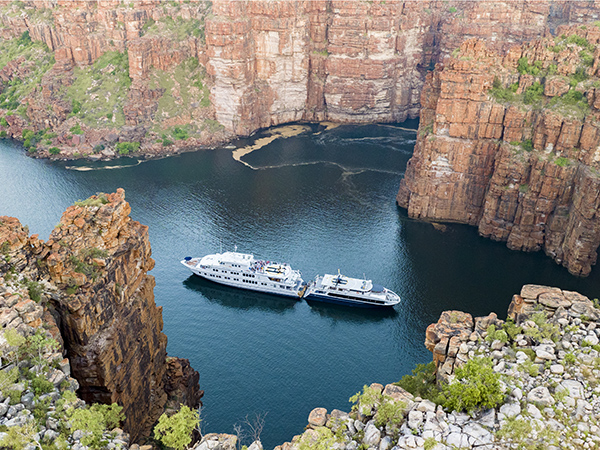
    Vast, rugged and deeply spiritual, the Kimberley coast in Australia’s North West feels a world away from everyday Australia – and there are countless ways to explore it. But if you want to reach ancient rock art, hidden gorges and lonely waterfalls, it has to be by boat. Whether you’re aboard a nimble expedition vessel or a luxury yacht with all the trimmings, exploring by the water brings exclusive experiences, shows unique views and makes travel easier than any other mode. And that’s just the beginning of Australia’s North West cruises.

    The True North Adventure Cruise in between sandstone cliffs.
    Adventure starts where the road ends.

    1. Discover Broome, and beyond

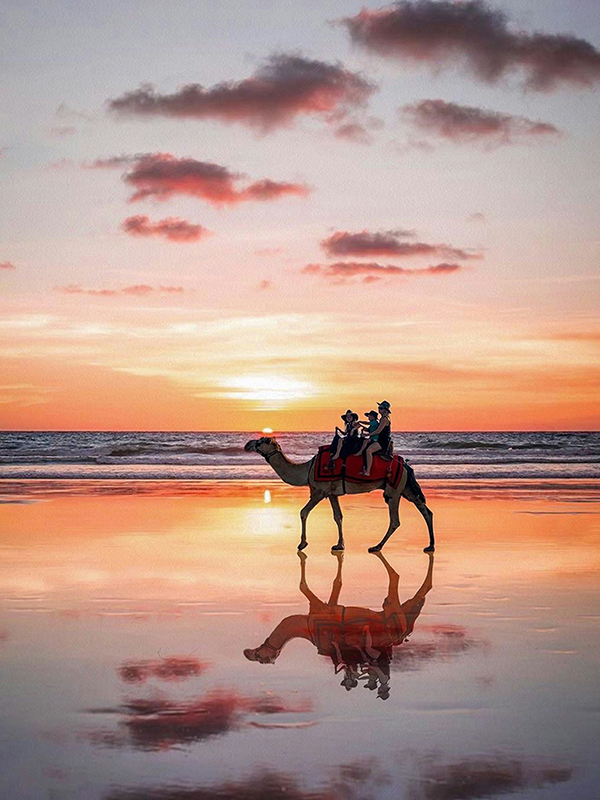
    Explore your launchpad before you set sail: Broome. Here camels and their riders stride along the 22 kilometres of powdery Cable Beach at sunset. That’s just the start.

    At Gantheaume Point, red pindan cliffs plunge into the turquoise sea, whose low tide uncovers fossilised dinosaur footprints. Broome’s pearling history runs deep. Japanese, Chinese, Malay and Aboriginal divers once worked these waters, and their legacy lives on in boutiques where South Sea pearls still shine.

    If the moon’s right, you may catch the Staircase to the Moon over Roebuck Bay. Or simply kick back with a cold beverage and a film under the stars at Sun Pictures, screening since 1916.

    Ride a camel along Cable Beach as the sun sinks into the Indian Ocean, casting golden light across the sand and sea.
    Ride a camel along Cable Beach. (Image: Nick Dunn)

    2. Unmatched access to The Kimberley

    Once you’re onboard, expect a backstage pass to some of the most isolated places on Earth. No roads. No ports. No phone reception.

    At Horizontal Falls/ Garaanngaddim, 10-metre tides surge through twin gorges like a natural waterpark ride that’ll make your palms sweat. Then there’s Montgomery Reef/ Yowjab: a giant living platform of coral and seagrass, where the sea pulls back to reveal waterfalls, sea turtles and ospreys.

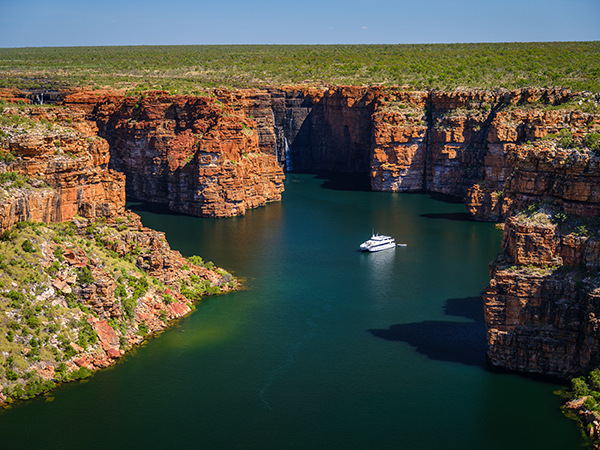
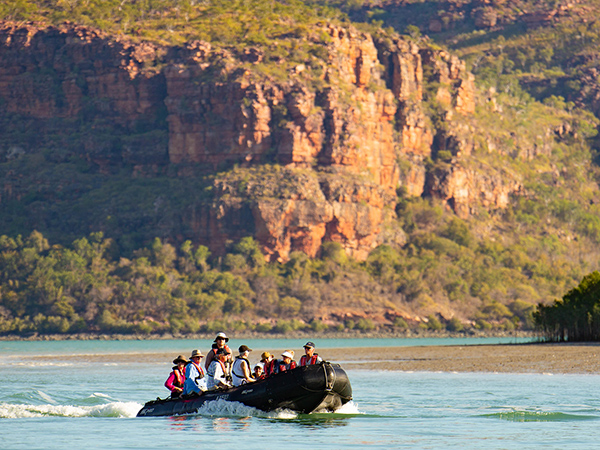
    Up north, King George Falls/ Oomari rage 80 metres down red cliffs. Zodiac boats often nudge in closer so you can feel the spray on your sun-warmed cheeks. You might even fly in to reach Mitchell Falls/ Punamii-unpuu, a four-tiered cascade where you can swim in freshwater pools above the drop.

    Come spring, some itineraries veer west to Rowley Shoals: an atoll chain of white sand and reef walls. Then it’s up the winding Prince Regent River to King Cascade/ Maamboolbadda, tumbling over rock terraces, and into a Zodiac to view the Gwion Gwion rock art, whose slender, ochre-painted figures are older than the pyramids.

    A cruise drifts beneath King George Falls, where sheer sandstone cliffs frame the thunderous plunge into turquoise waters.
    Get closer to the Kimberley than ever before.

    3. Taste the Kimberley with onboard hospitality

    You might spend your days clambering over slippery rocks or charging past waterfalls. But when you’re back on the water, it’s a different story. Meals are chef-prepared and regionally inspired: grilled barramundi, pearl meat sashimi, mango tarts, and bush tomato chutney. One night it’s barefoot beach barbecues with your shipmates; the next, alfresco dining on the ship.

    Small expedition ships each have their own personality, but many carry just 12 to 36 guests, making being out on the water a whole other experience. You might sink into a spa on the foredeck or sip coffee in a lounge while watching crocodiles cruise by. It’s choose-your-own-relaxation, Kimberley style.

    4. Expert-led excursions through the Kimberley

    These voyages are led by people who know the Kimberley like the back of their sunburnt hand. Attenborough-esque naturalists might gently tap your shoulder to point out rare birds or tell the story beneath a slab of rock. Historians can explain exactly how that rusted World War II relic came to rest here.

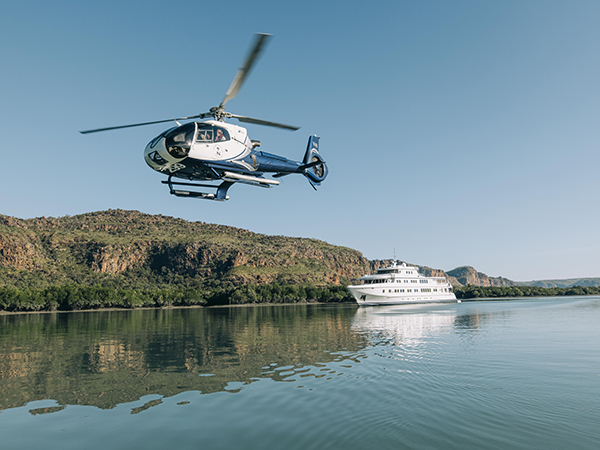
    If your ship has a helipad, you might chopper straight to a waterfall-fed swimming hole. If not, you’ll still be hopping ashore for that wet landing at a secret creek.

    Then come the evenings: songlines shared by Traditional Owners under the stars, or astronomy sessions that link what’s overhead with what’s underfoot and what’s within.

    A small group glides through Kimberley’s rugged coastline by boat, passing ancient cliffs.
    Explore with naturalists and historians by your side.

    5. Relax in luxurious lodgings

    Just because you’re off-grid doesn’t mean you have to rough it. These Kimberley vessels are small in size, but mighty in luxury. True North’s ships come with their own helicopters and a no-sea-days policy, so you’re always in the thick of it. Try the luxurious offerings from Ocean Dream Charters for exploration in style. Kimberley Quest offers a fast boat for easy, off-ship adventures. On the larger end of the scale, Coral Expeditions has open-deck bars and curated wine cellars. And then there’s Ponant’s luxury yachts – sleek and incredibly stylish French sailing yachts.

    A helicopter soars above the sea, with a sleek cruise ship gliding in the distance.
    See the Kimberley from sky to shore.

    6. The adventure continues with pre- and post-cruise experiences

    You’ve already come this far – so, why not go further? Broome makes it easy to ease in before you board, or wind down when your voyage ends, and there is no reason to stop there.

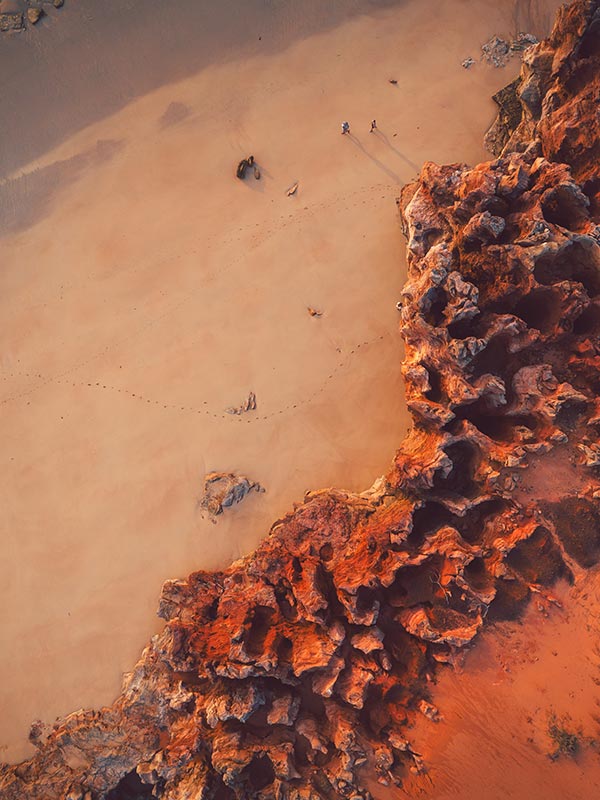
    Head an hour and a half south to Eco Beach to stay off-grid and off the clock. Join a Yawuru guide for a mangrove walk or ocean forage. Dive even deeper into Broome’s pearling past at Willie Creek or Cygnet Bay, where divers and craftspeople still pull the seawater-slicked gems from the deep.

    If you’re still craving adventure, it’s time to go further. Soar over the Buccaneer Archipelago, or detour inland with a 4WD trip along the Gibb River Road. Book a scenic flight over the Bungle Bungles. Or – because you never know when you’ll be back – do all three.

    aerial of people walking on eco beach in the kimberley western australia
    Stay off grid at Eco Beach. (Image: Tourism WA)

    Find out more about your trip to Australia’s North West at australiasnorthwest.com.