Meteors, supermoons, a comet: a guide to the southern sky in 2024

hero media
What exciting events will we see in the southern sky in 2024? Meteor showers, Saturn covered by the Moon, close approaches of bright planets to each other, supermoons – and, if we’re lucky, a comet visible to the naked eye.

Even if you live in a city surrounded by light pollution, these are all worth looking out for. Here are some of the highlights.

May – the Eta Aquarid meteors

The first of the two main Southern Hemisphere meteor showers during the year is the Eta Aquariid or Eta Aquarid shower. It’s named after a star in the constellation of Aquarius, the Water Carrier, as the meteors appear to originate from there.

Meteors are small particles hitting Earth’s atmosphere and creating a streak of light as they burn up. A meteor shower occurs when many particles hit, all coming from the same direction.

They are generally due to Earth passing through a stream of dust left behind by a comet. For the Eta Aquariids, the comet is the famous Halley’s Comet, which was first recorded more than 2,000 years ago.

In 2024, there will be a good opportunity to see them in the early mornings of Monday 6 and Tuesday 7 May, as the Moon will not be brightening the sky.

December – the Geminid meteors

The second of the two main meteor showers is the Geminid shower. This originates in the direction of the constellation of Gemini, the Twins.

Unusually, they are associated not with a comet but with a rocky asteroid named Phaeton. In 2024, they are likely to be best seen early on the morning of Saturday 14 December.

The peak time to view is during the short interval between the setting of the Moon and the start of dawn.

Need tips, more detail or itinerary ideas tailored to you? Ask AT.

AI Prompt

March, June and August – the planets

Celestial objects approaching one another in the sky can provide a nice view. On the evening of Friday 22 March, the brightest planet Venus is less than the width of the Moon away from the ringed planet Saturn. Look low down in the east.

For people in the eastern part of Australia, the Moon covers the planet Saturn low in the eastern sky on the night of Thursday 27 June. The event can be seen by eye, but binoculars or a small telescope would help.

It is safe to take images or video. From Sydney, Saturn disappears at the bright edge of the Moon at 10:55pm and reappears at its dark edge at 11:41pm. The times for Brisbane, Canberra and Melbourne are similar.
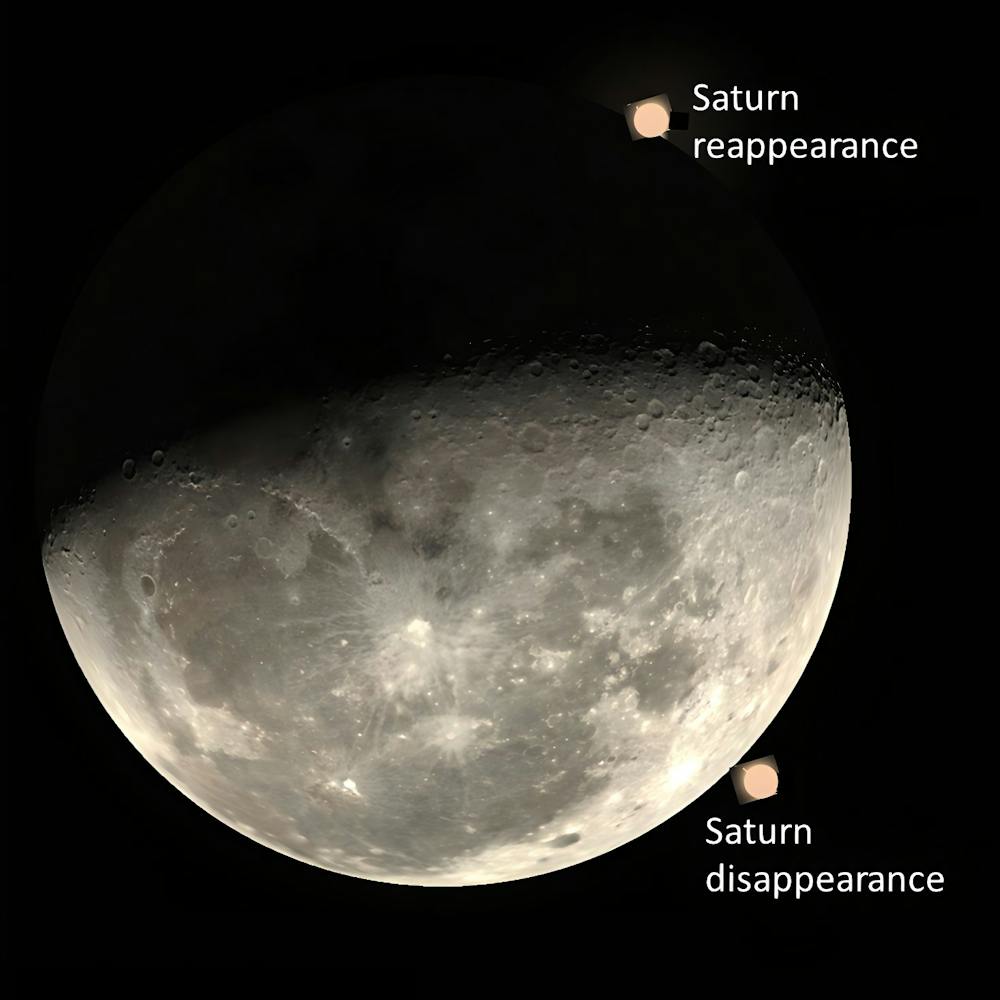
Diagram showing Saturn disappearing behind the Moon and later reappearing.

The occultation or covering of Saturn on Thursday 27 June 2024. (Image: Nick Lomb / Stellarium)

Another close approach is in the early morning of Thursday 15 August, when the red planet Mars is less than a Moon-width from the giant planet Jupiter.

September and October – supermoons

There will be two supermoons during 2024. The Moon has a path that sometimes takes it further from Earth and sometimes closer.

Recently, a time when the full Moon coincides with the Moon at its closest point to Earth has become known as a supermoon. At this time the Moon is slightly larger in the sky than usual.

It’s best to look at moonrise, as an illusion in our brains makes the Moon appear larger when it’s near the horizon. The supermoons in 2024 are on Wednesday 18 September and Thursday 17 October.

October – Comet C/2023 A3 (Tsuchinshan-ATLAS)

Comets visible to the naked eye are rare and exciting events. A comet with the impressive name of Comet C/2023 A3 (Tsuchinshan-ATLAS), discovered in January 2023, is approaching the Sun and Earth, and may become bright enough to be easily seen. As yet, it is unknown whether this will happen – comets are notoriously fickle.

At a distance of 71 million kilometres, the comet will be closest to Earth on Sunday 13 October. However, for the next six days a bright Moon will make sighting it unlikely.

By Saturday 19 October, the Moon will have moved out of the way. That evening and the following few evenings will give us the best chance to see it. Look low in the west.

January and May – constellations

Not only these highlighted events can be seen in the sky. There are star pictures or constellations that still stand out in the sky of bright cities.

Orion, the Hunter, is a favourite Southern Hemisphere summer constellation, high in the northern sky on January evenings. It consists of four bright stars in a rectangle with a line of three stars, representing Orion’s belt, in the middle.
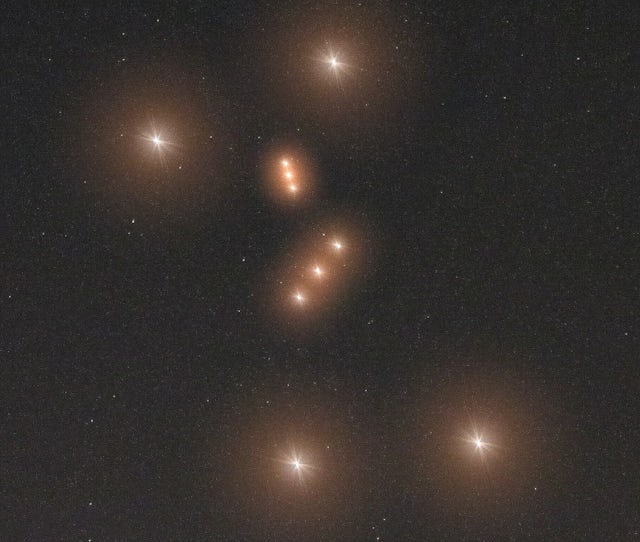
A photo of the constellation Orion.

The constellation Orion is named for a hunter from Greek myth. (Image: Nick Lomb)

According to Greek legend, Orion was a great hunter who vowed to kill all animals. To stop him carrying out his threat, one of the gods sent a scorpion to kill him. This ancient story with Scorpius, the Scorpion chasing Orion takes place above our heads each night.
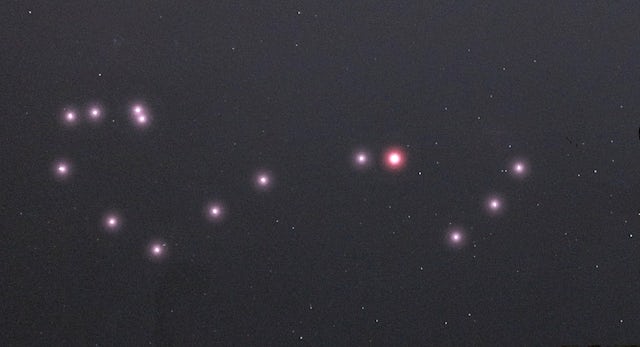
A photo of the constellation Scorpius.

The constellation Scorpius is named for its resemblance to a scorpion. (Image: Nick Lomb)

Scorpius is another spectacular constellation with a curved line of bright stars, with a red star forming the creature’s heart. In January, people who are up at around 3 am can see Scorpius rising in the east, while its quarry Orion is sinking in the west. Alternatively, if you don’t like early mornings you can see the same scene on May evenings after dusk.

The information in this article is from the 2024 Australasian Sky Guide. The guide contains monthly star maps and has much more information to assist with viewing and enjoying the night sky from Australia and New Zealand.The Conversation

This article is republished from The Conversation, the world’s leading publisher of research-based news and analysis. It was written by: Nick Lomb, University of Southern Queensland.

Want to see more stories from Australian Traveller in your Google search results?

  1. Click here to set Australian Traveller as a preferred source.
  2. Tick the box next to "Australian Traveller". That's it.
Nick Lomb
I have had a variety of research directions over my career. During my PhD project on short period variable stars, I developed the theory of least squares frequency analysis for unequally spaced data. This is now a standard method of numerical analysis, called the Lomb or Lomb-Scargle Periodogram, that is used in astronomy and other fields. Later at Sydney Observatory, the focus was on astrometry, that is, the positions and motions of stars and solar system objects. This work culminated in the publication of a star catalogue, of which I was co-author. Then, when the Observatory came under the auspices of the Museum of Applied Arts and Sciences, I became the Museum’s Curator of Astronomy. As such, I planned exhibitions and collected and looked after instruments and other items relating to astronomy. I was also involved with the media and with public education and outreach. On leaving the Observatory and the Museum, my research emphasis became the history of Australian astronomy, with my latest book, with Toner Stevenson, 'Eclipse Chasers', to be released in March 2023. As well, I continue to prepare the annual Australasian Sky Guide for Powerhouse Publishing and maintain my interest in combatting light pollution.
View profile and articles
hero media

An insider’s guide to Noosa’s best-kept winter secrets

    Lucy Cousins Lucy Cousins
    As the cooler weather rolls in, head to this popular Sunshine Coast destination to enjoy stunning natural beauty, culinary wonders and mild temperatures.

    As southern Australia’s weather starts to cool – the frost visiting every morning and the evening chill descending at dusk – you might reach for your thickest cable knit sweater and warmest blanket. But why not reach for your suitcase and sunglasses and book a ticket to Noosa in winter instead?

    Sure, it’s a favourite destination for sun-seeking summer travellers. But as locals will readily tell you, winter is the best time to uncover hidden gems across the region – not only is the weather mild and enjoyable, but the beaches and hinterland are picture-perfect, too. You might even spot a whale or two if you visit from June to September.

    Discover how to spend your winter surrounded by Noosa’s stunning natural beauty.

    Noosa Rivermouth And Main Beach
    Make the most of mild temperatures of Noosa in winter.

    Where to eat in Noosa

    Known for its dynamic cuisine, Noosa is an overflowing foodie destination. Whatever your tastebuds fancy, the region has it covered.

    There are the classic eateries, like lively beachfront Bistro C (try the caramelised pork belly), popular Season Restaurant on Hastings Street (order the spanner crab pasta) and stylish Locale (our pick is the slow roasted White Pyrenees lamb shoulder).

    There are also chic new restaurants offering tasty dishes, like the Mediterranean fare at Pelis, Cantonese-inspired dim sums at Sabrosa, organic sourdough pizza from El Capitano, traditional recipes and tequila at Dona Cocina Mexicana and modern Italian-Australian creations from Lucio’s Marina.

    diners at Lucio's Marina in noosa in winter
    Taste modern Italian-Australian at Lucio’s Marina. (Image: Nickolas May)

    Where to stay in Noosa

    Once you’re full, you’ll need to find a place to lay your head, and Noosa has no shortage of accommodation options. From five-star resorts with palm-fringed lagoon pools to self-catered apartments and family-friendly budget options, stays in the heart of the action on Hastings Street to sleeping steps from the beach or in more spacious and relaxed accommodation along the river, Noosa offers something for everyone.

    There’s the laid-back luxury of Netanya Noosa overlooking Noosa Main Beach, which offers studios, two- and three-bedroom apartments, or the family-oriented Ivory Palms Resort in Noosaville, with its three pools, jumping pillow and playground. Guests also love the versatile RACV Noosa Resort and its numerous pools, waterslides and tennis courts.

    For a wildlife experience, hop on a ferry and travel to the eco-friendly Senses Noosa North Shore. Surrounded by 16 hectares of native bushland, the beautiful architect-designed property blends indoor and outdoor living and offers three stunning pools and a spa. Guests can even spot kangaroos and rainbow lorikeets from shaded verandahs.

    a beachfront swimming pool at Netanya Noosa
    Gaze over Noosa Main Beach at Netanya Noosa. (Image: Lumea Photo)

    Things to do on land

    There’s no denying it, the main beach – with its creamy-coloured sand, consistent breaks and epic coastline views – is Noosa’s shining star attraction. Bordering this is the wildly popular Noosa National Park, where you can explore over 15 kilometres of walking tracks, including options like the Coastal Walk, Tanglewood Walk and Palm Grove Walk.

    A short stroll away is busy Hastings Street, which is full of life during the day and long into the night. Enjoy a little shopping, a late brunch, dinner out and a cocktail as the sun goes down.

    Climb onto a fully electric tuk tuk with Noosa e-TukTuk to get an insider’s tour of the region. For a more in-depth exploration, book a bespoke tour with Joel’s Journeys and head to the lush green hinterland, or discover the rugged landscapes of Great Sandy National Park with Sunny Jeeps to spend the day with the wind in your hair and sand underfoot.

    woman enjoying the view after hiking through Noosa National Park, noosa in winter
    Take in views of the beautiful Noosa Hinterland. (Image: Demy Gavin)

    Things to do in the water

    Noosa isn’t just about the beach, the national parks and shopping; one of the most popular ways to embrace winter is to explore on water.

    You could brave the waves on a surfboard, explore the languid Noosa River on a stand-up paddleboard or even head to the Noosa Everglades for a day adventuring on a boat, canoe or kayak.

    Enjoy the winter sunsets aboard the newly launched HV Stillwater, a luxury, hybrid-powered catamaran that glides silently along Noosa’s waterways. You can also book a table on the only floating restaurant on the river – Noosa Cruiser – and dig into freshly cooked cuisine.

    For a little more adventure, head out with Kingfisher Safari Co and cruise around the Noosa River Inlet and Lake Cootharaba. Or search for whales and dolphins (from June to September) on a small charter boat tour with WhaleSongs Noosa; with an onboard researcher to explain what you’re seeing, as well as a hydrophone, you’ll be able to listen to the haunting songs of some of the world’s biggest animals while enjoying a winter’s day in the sun.

    women kayaking through Noosa everglades noosa in winter
    Explore the gorgeous Noosa Everglades. (Image: Emily Redfern)

    Book your winter getaway in Noosa at visitnoosa.com.au.

    Meteors, supermoons, a comet: a guide to the southern sky in 2024 - Australian Traveller