The ultimate guide to Namadgi National Park

hero media
Taking up almost half of the Australian Capital Territory, Namadgi National Park is one of Australia’s greatest natural wonders.

Namadgi National Park represents 46 per cent of the ACT, lying just 40 minutes southwest of Canberra City with more than 106,000 hectares of alpine, sub-alpine and mountain areas.

Since it was first declared a national park in 1984, this immensely diverse region has been a source of great inspiration for nature lovers, offering an incredible range of landscapes from grassy pains and snow gum woodlands to sub-alpine meadows and hidden fern gullies.

It’s often unexplored because visitors are unsure of what to do with something so wonderfully vast. To help, we’ve rounded up some of the top things to do in Namadgi National Park so you can make the most of your visit to this important, largely underappreciated, part of Australia’s geographically diverse east coast.

1. Search the national park for historic huts
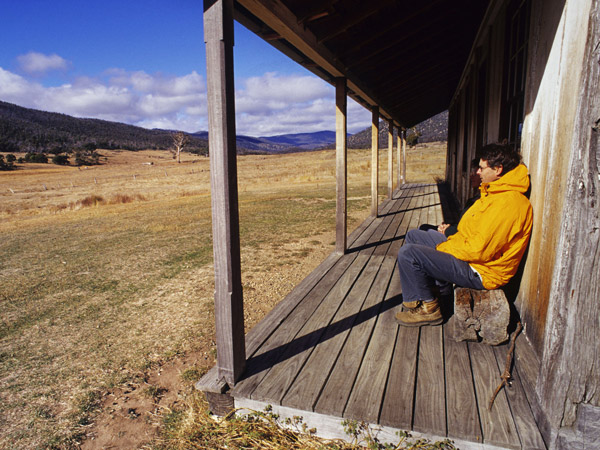
a man sitting outside a homestead, Orroral
The Orroral homestead was built in the 1860s and has stood the test of time. (Image: Michael Maconachie)

Several historic homesteads lie across Namadgi National Park, retelling the story of colonial pastoralists and early recreational skiers. Filled with character, these homes are not only great photo opportunities but they tell the story of this region with every crack and crevice.

Gudgenby, for example, is a timber slab hut built in 1845. After serving time in a shipping container, it’s been beautifully restored and reconstructed near the Namadgi National Park visitors’ centre and can be viewed anytime. Audio features retelling tales of early settlers help contextualise the park before you set off to explore.

You’ll also want to look for Orroral, the park’s oldest original homestead which was built in the 1860s and can be found near the Orroral campground.

2. Walk to Booroomba Rocks
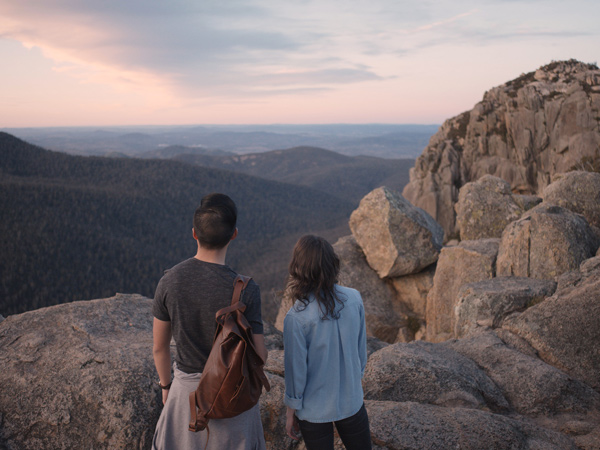
a couple standing atop Booroomba Rocks, Namadgi National Park
One of Namadgi’s best walks, hiking to Booroomba Rocks affords spectacular views. (Image: Visit Canberra)

If you’ve only got time for one hiking trail in Namadgi National Park, take the short 2.5 Booroomba Rocks tail up to the park’s most cinematic section. The 40-minute walk will take you through tall forests up to sweeping granite cliffs surrounded by big, beautiful boulders.

With great views of the Brindabella Range, this is one of the most scenic walks in the state, starting from Booroomba Park Park with clear markings along the way.

The walk is best done in spring when the area is blanketed in beautiful multi-coloured wildflowers like yellow and orange peas, daisies and flax lilies. Keep an eye out for Canberra’s signature royal bluebells along some of the wetter areas of the trail.

Need tips, more detail or itinerary ideas tailored to you? Ask AT.

AI Prompt

3. See Australia’s tallest mountain range
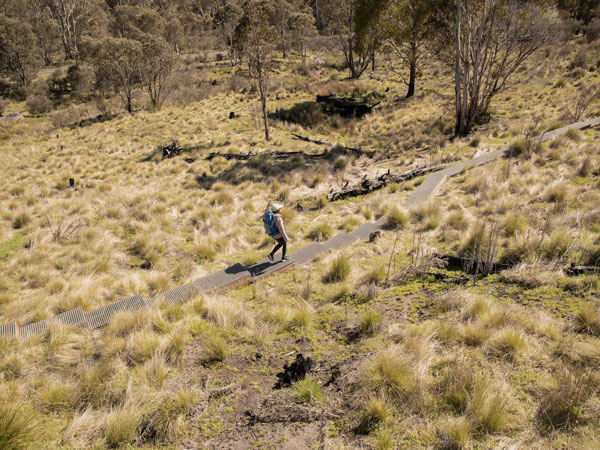
a woman walking along the Mount Tennent Trail, Canberra
Mount Tennent Trail is one of Canberra’s hardest walking trails. (Image: We Are Explorers for VisitCanberra)

Namadgi National Park is notable for many reasons, though mostly because it forms the northern tip of the Australian Alps. The various microclimates created by Australia’s tallest mountain range mean the park has an incredible diversity of environments, from steep slopes and open plateaus to dramatic alpine meadows strewn with natural beauty.

The best way to experience this end of the Australian Alps is by walking the 13.7-kilometre Mount Tennent Trail. Challenging as it may be, this is one of the most rewarding walks in Australia, taking you through many of these landscapes across five hours.

4. Pitch a tent
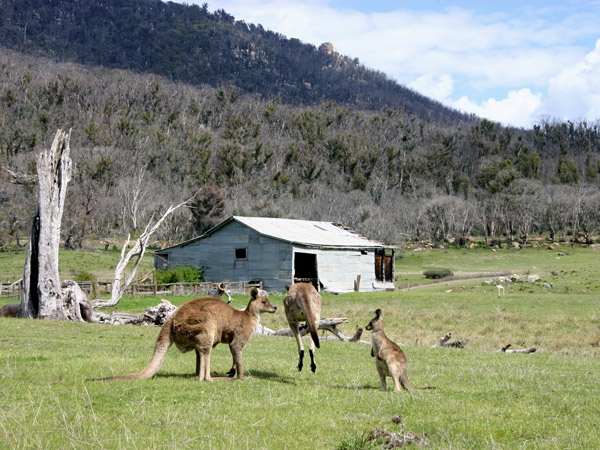
kangaroos grazing on the field, Orroral
Spot kangaroos grazing on lush green grass. (Image: Visit Canberra)

Camping in Namadgi National Park is allowed at either of three designated campgrounds – Orroral, Mt Clear, or Honeysuckle. And each offers a remarkably different experience for those who want to really give themselves over to this cinematic slice of Australia.

Orroral Campgrounds is ideal for anyone wanting easy access to the picturesque Orroral Heritage Walking Track, which is around 6 kilometres one-way and should take around 2.5 hours to complete. Mt Clear is preferred for its bounty of historic huts nearby. Meanwhile, Honeysuckle is frequented by history buffs, keen to camp at the actual spot where the world’s first vision of the moon landing was transmitted.

If you don’t want to camp, hire out the historic Ready-Cut Cottage instead. The heritage cottage can sleep up to seven and is positioned in one of the most beautiful areas of the park near the Gudgenby River.

Weekly travel news, experiences
insider tips, offers, and more.

5. Look for Indigenous rock art
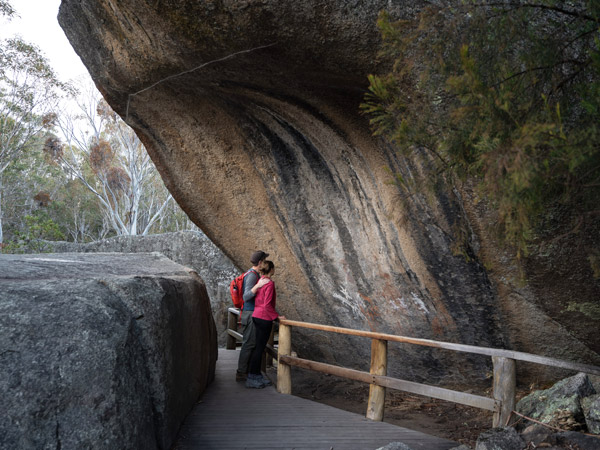
a couple admiring ancient Aboriginal paintings at Yankee Hat rock art site
See ancient Aboriginal paintings at Yankee Hat rock art site. (Image: Tourism Australia)

There are plenty of things that make Namadgi National Park one of the most historically significant regions in Australia. Although the primary reason would be more than 200 recorded Aboriginal sites, not only covered with fascinating rock art but plenty of other details best showcased by Dhawura Tours on one of their custodian-led itineraries.

6. Spot the incredible flora and fauna
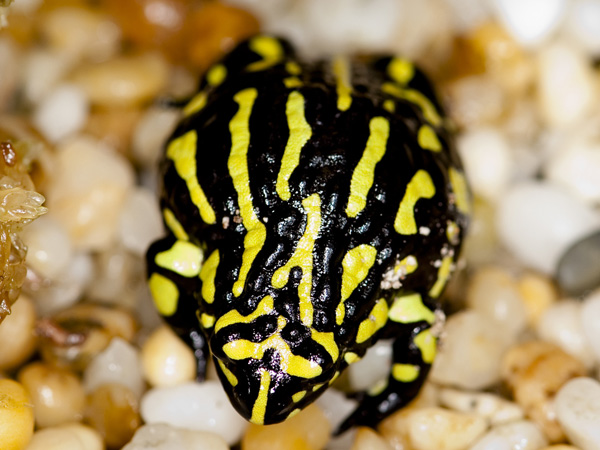
a Corroboree Frog in Namadgi National Park
Only hundreds are left of the Critically Endangered Northern Corroboree Frogs (NCF) in the wild. (Image: Visit Canberra)

Namadgi National Park is also one of the most bountiful regions of on Australia’s east coast, rivalling Western Australia when it comes to beautiful, multi-coloured wildflowers. Search the park and you might even spot the reddish-purple Brindabella midge orchid, found nowhere else on Earth.

You’ll almost certainly bump into kangaroos and wallabies but Namadgi is home to 13 threatened species so wildlife encounters are pretty much a given. This also includes wombats, gliders, lyrebirds, wedge-tail eagles and the critically endangered Northern Corroboree Frog.

Discover the best things to do in Canberra.

Want to see more stories from Australian Traveller in your Google search results?

  1. Click here to set Australian Traveller as a preferred source.
  2. Tick the box next to "Australian Traveller". That's it.
Chris Singh
Chris Singh is an arts, travel and food journalist with 17 years of experience in digital media and 4 years of experience in SEO writing. He is the former travel editor of premium men's lifestyle title Boss Hunting and currently balances his role as Deputy Editor-At-Large of the AU review with freelance travel writing gigs at Australian Traveller, Luxury Escapes, Cruise & Travel and Sydney Travel Guide. Chris holds a Bachelor of Arts & Sciences (Sociology and Psychology) from the University of Sydney and once worked as a line dancer for steakhouse chain Lone Star (no, seriously). He's always got his finger on the pulse for good live music and delicious new restaurants, has a particular love of historic hotels and is starting to see the restorative value of the ever-present wellness industry. Although he is a born-and-bred Sydneysider, his favourite Australian cities are Hobart and Adelaide. Internationally, he can never get enough of big cities like Tokyo, New York and Chicago. If you're looking for him, he's either at a concert, on a plane or behind a laptop.
View profile and articles
hero media

An insider’s guide to Noosa’s best-kept winter secrets

    Lucy Cousins Lucy Cousins
    As the cooler weather rolls in, head to this popular Sunshine Coast destination to enjoy stunning natural beauty, culinary wonders and mild temperatures.

    As southern Australia’s weather starts to cool – the frost visiting every morning and the evening chill descending at dusk – you might reach for your thickest cable knit sweater and warmest blanket. But why not reach for your suitcase and sunglasses and book a ticket to Noosa in winter instead?

    Sure, it’s a favourite destination for sun-seeking summer travellers. But as locals will readily tell you, winter is the best time to uncover hidden gems across the region – not only is the weather mild and enjoyable, but the beaches and hinterland are picture-perfect, too. You might even spot a whale or two if you visit from June to September.

    Discover how to spend your winter surrounded by Noosa’s stunning natural beauty.

    Noosa Rivermouth And Main Beach
    Make the most of mild temperatures of Noosa in winter.

    Where to eat in Noosa

    Known for its dynamic cuisine, Noosa is an overflowing foodie destination. Whatever your tastebuds fancy, the region has it covered.

    There are the classic eateries, like lively beachfront Bistro C (try the caramelised pork belly), popular Season Restaurant on Hastings Street (order the spanner crab pasta) and stylish Locale (our pick is the slow roasted White Pyrenees lamb shoulder).

    There are also chic new restaurants offering tasty dishes, like the Mediterranean fare at Pelis, Cantonese-inspired dim sums at Sabrosa, organic sourdough pizza from El Capitano, traditional recipes and tequila at Dona Cocina Mexicana and modern Italian-Australian creations from Lucio’s Marina.

    diners at Lucio's Marina in noosa in winter
    Taste modern Italian-Australian at Lucio’s Marina. (Image: Nickolas May)

    Where to stay in Noosa

    Once you’re full, you’ll need to find a place to lay your head, and Noosa has no shortage of accommodation options. From five-star resorts with palm-fringed lagoon pools to self-catered apartments and family-friendly budget options, stays in the heart of the action on Hastings Street to sleeping steps from the beach or in more spacious and relaxed accommodation along the river, Noosa offers something for everyone.

    There’s the laid-back luxury of Netanya Noosa overlooking Noosa Main Beach, which offers studios, two- and three-bedroom apartments, or the family-oriented Ivory Palms Resort in Noosaville, with its three pools, jumping pillow and playground. Guests also love the versatile RACV Noosa Resort and its numerous pools, waterslides and tennis courts.

    For a wildlife experience, hop on a ferry and travel to the eco-friendly Senses Noosa North Shore. Surrounded by 16 hectares of native bushland, the beautiful architect-designed property blends indoor and outdoor living and offers three stunning pools and a spa. Guests can even spot kangaroos and rainbow lorikeets from shaded verandahs.

    a beachfront swimming pool at Netanya Noosa
    Gaze over Noosa Main Beach at Netanya Noosa. (Image: Lumea Photo)

    Things to do on land

    There’s no denying it, the main beach – with its creamy-coloured sand, consistent breaks and epic coastline views – is Noosa’s shining star attraction. Bordering this is the wildly popular Noosa National Park, where you can explore over 15 kilometres of walking tracks, including options like the Coastal Walk, Tanglewood Walk and Palm Grove Walk.

    A short stroll away is busy Hastings Street, which is full of life during the day and long into the night. Enjoy a little shopping, a late brunch, dinner out and a cocktail as the sun goes down.

    Climb onto a fully electric tuk tuk with Noosa e-TukTuk to get an insider’s tour of the region. For a more in-depth exploration, book a bespoke tour with Joel’s Journeys and head to the lush green hinterland, or discover the rugged landscapes of Great Sandy National Park with Sunny Jeeps to spend the day with the wind in your hair and sand underfoot.

    woman enjoying the view after hiking through Noosa National Park, noosa in winter
    Take in views of the beautiful Noosa Hinterland. (Image: Demy Gavin)

    Things to do in the water

    Noosa isn’t just about the beach, the national parks and shopping; one of the most popular ways to embrace winter is to explore on water.

    You could brave the waves on a surfboard, explore the languid Noosa River on a stand-up paddleboard or even head to the Noosa Everglades for a day adventuring on a boat, canoe or kayak.

    Enjoy the winter sunsets aboard the newly launched HV Stillwater, a luxury, hybrid-powered catamaran that glides silently along Noosa’s waterways. You can also book a table on the only floating restaurant on the river – Noosa Cruiser – and dig into freshly cooked cuisine.

    For a little more adventure, head out with Kingfisher Safari Co and cruise around the Noosa River Inlet and Lake Cootharaba. Or search for whales and dolphins (from June to September) on a small charter boat tour with WhaleSongs Noosa; with an onboard researcher to explain what you’re seeing, as well as a hydrophone, you’ll be able to listen to the haunting songs of some of the world’s biggest animals while enjoying a winter’s day in the sun.

    women kayaking through Noosa everglades noosa in winter
    Explore the gorgeous Noosa Everglades. (Image: Emily Redfern)

    Book your winter getaway in Noosa at visitnoosa.com.au.